FREE LESSON 1
WHY THE FOUR RULES EXIST
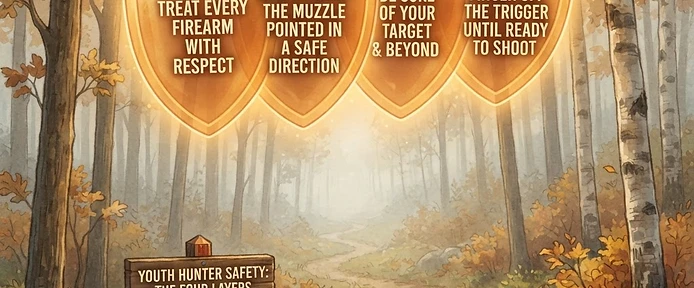
You're at the age where adults will start trusting you with real responsibility in the field — and that trust has to be earned with discipline, not enthusiasm. When incident investigators analyze firearm accidents in hunting, they find the same pattern in case after case: an experienced person decided, just once, that a rule didn't apply to them. The gun was 'unloaded.' The shape was 'obviously' a deer. The finger was on the trigger 'just for a second.'
The four rules — remembered as TAB-K — are the direct product of those investigations: Treat every firearm as if it is loaded. Always point the muzzle in a safe direction. Be certain of your target and what lies beyond it. Keep your finger outside the trigger guard until you've decided to shoot.
Understand the engineering behind them: the rules are deliberately redundant. Each one independently prevents a tragedy, so a single mistake never becomes a catastrophe — only a simultaneous failure of multiple rules can. That's why complacency is the real enemy. Every rule you skip removes a layer of protection, and you never know which layer you'll need. Hunters with decades of experience follow all four with more discipline than beginners, not less.
- Nearly all firearm accidents trace to an experienced person making a one-time exception
- TAB-K rules are deliberately redundant — a single failure stays harmless only if the other layers hold
- Discipline should increase with experience; complacency is the leading killer in the field
FIELD NOTE · Discuss with your mentor: describe a moment where you might feel pressure to skip a rule — end of a long day, a big buck, friends watching — and how you'd hold the line.